
 한국어
 日本語
 简体中文
 Español
Foods to Avoid With Fatty Liver, Best Foods to Eat + Sample Day
The best foods for fatty liver are those rich in fiber and healthy fats, like vegetables, whole grains, beans, fish, olive oil and nuts. The main foods to limit are sugary drinks, fruit juice, alcohol, white bread, processed meats and fried foods. More important than any single food, though, is managing your overall portions so you lose weight gradually. Below you'll find food tables, a sample day of eating, and tips for ordering when you eat out.
What is fatty liver?
Fatty liver is a condition in which fat makes up 5% or more of the liver's weight. It can be caused by heavy drinking (alcohol-related fatty liver), but far more common today is fatty liver in people who drink little or no alcohol. It used to be called nonalcoholic fatty liver disease (NAFLD); in 2023, international liver societies introduced a new name, MASLD (metabolic dysfunction-associated steatotic liver disease), to highlight its link with metabolic health.
This type of fatty liver often appears together with:
- Excess weight, especially around the belly
- Type 2 diabetes or prediabetes (insulin resistance)
- High triglycerides or low HDL ("good") cholesterol
- High blood pressure
Most people with fatty liver have no symptoms, so it's often first found on an ultrasound or through liver enzyme tests (ALT, AST) during a checkup. In some people it can progress to liver inflammation and scarring (fibrosis), so if a test shows fatty liver, the first step is to have your doctor check exactly where things stand.
Why does weight matter most for fatty liver?
A fatty liver diet is about "how much" as well as "what." Both the AASLD practice guidance and the European guidelines name lifestyle change — above all, weight loss — as the foundation.
| Weight loss (for a 200 lb / 91 kg person) | What it may help with |
|---|---|
| 3–5% (6–10 lb / 3–4.5 kg) | Reducing liver fat |
| 7–10% (14–20 lb / 6–9 kg) | Improving liver inflammation |
| 10% or more (20 lb+ / 9 kg+) | Studies link it with improvement in fibrosis |
Rather than crash dieting, losing about 1–2 lb (0.5–1 kg) a week is easier on your body. A common approach is eating about 500 calories less per day than usual.
How much of this meal can I have today? One photo and the AI tells you →What are the best foods for fatty liver?
The best foods have a few things in common: lots of fiber, unsaturated fats instead of saturated fats, and minimal processing. The European guidelines recommend a Mediterranean-style diet, which is built on these foods.
| Foods to eat more of | Examples |
|---|---|
| Vegetables and leafy greens | Broccoli, spinach, cabbage, salad greens |
| Whole grains | Oatmeal, brown rice, quinoa, whole-wheat bread |
| Beans and soy | Lentils, chickpeas, black beans, tofu, edamame |
| Fish | Salmon, sardines, mackerel, trout |
| Healthy oils and nuts | Olive oil, walnuts, almonds |
| Lean protein | Chicken breast, eggs, lean meat |
| Whole fruit | Apples, berries, oranges (in moderation) |
Why might these help?
- Vegetables: low in calories and high in fiber, so they help you feel full.
- Whole grains: raise blood sugar more slowly than white rice or white bread.
- Beans and soy: provide plant protein and fiber together.
- Fish: rich in unsaturated fats such as omega-3s.
- Healthy oils and nuts: a good swap for saturated fats like butter. Nuts are calorie-dense, so stick to about a handful.
- Lean protein: helps protect muscle while you lose weight.
- Whole fruit: unlike juice, it keeps its fiber.
In several observational studies, coffee drinkers had a lower risk of liver fibrosis. That doesn't prove cause and effect, and adding sugar, syrup or whipped cream adds sugar and calories instead. If you drink coffee, black or with a splash of milk is best.
What foods should you avoid with fatty liver?
The main foods to limit are drinks high in sugar (especially fructose), alcohol, refined carbs, and saturated fat and processed meats.
| Foods to cut back on | Examples |
|---|---|
| Sugary drinks | Soda, fruit juice, sweetened coffee drinks, sweet tea |
| Alcohol | Beer, wine, cocktails, liquor |
| Refined carbs | White bread, chips, cookies, cake, pastries |
| Processed and fatty meats | Ham, sausage, bacon, hot dogs, fatty cuts |
| Fried foods and fast food | Fried chicken, French fries, burgers |
- Sugary drinks: liquid sugar goes down fast without filling you up, and fructose is readily turned into fat in the liver.
- Alcohol: it puts extra strain on the liver and is high in calories.
- Refined carbs: they raise blood sugar quickly and make overeating easy.
- Processed and fatty meats: high in saturated fat and sodium.
- Fried foods and fast food: they add a lot of calories to a single meal.
WHO recommends keeping added (free) sugars to less than 10% of daily calories, and ideally under 5%. For someone eating 2,000 calories a day, 10% is about 50 g, or roughly 12 teaspoons. Many sweet drinks contain more than half of that in a single bottle or can. On US Nutrition Facts labels, look for the "Added Sugars" line — its %DV is based on 50 g a day.
Advice on alcohol depends on the type of fatty liver and the state of your liver. If you have fatty liver, cutting back or stopping is the safer choice, and how much (if any) is OK is something to discuss with your doctor.
What does a fatty liver diet look like for a day?
Here's a sample day of about 1,500–1,700 calories for gradual weight loss. How much you need depends on your height, weight and activity level.
| Meal | Menu |
|---|---|
| Breakfast | Oatmeal + plain Greek yogurt + berries |
| Lunch | About 2/3 cup brown rice, grilled salmon, a big side salad, a small cup of lentil soup |
| Snack | Half an apple + about 10 almonds |
| Dinner | Tofu or chicken salad with olive oil dressing + a small baked sweet potato |
| Drinks | Water, unsweetened tea, black coffee |
The key swaps: whole grains instead of sweet cereal and pastries, smaller portions of white rice and pasta, fish and tofu for protein, whole fruit and nuts instead of chips and juice, and grilled or baked dishes instead of fried ones.
Eating order may help too. Having vegetables first, then protein, and carbs last tends to soften the rise in blood sugar. For details, see eating order for blood sugar.
How do you order when eating out?
- Steakhouses and BBQ: choose sirloin, chicken or fish over ribs and fatty cuts, load up on salad or grilled vegetables, and have half the potatoes or bread.
- Sit-down restaurants: pick grilled fish or chicken plates, grain bowls or big salads with protein. Ask to swap fries for vegetables.
- Mexican: a burrito bowl with extra fajita vegetables, beans and salsa, light on cheese and sour cream, instead of a large burrito or nachos.
- Asian takeout: steamed or stir-fried dishes with lots of vegetables over fried, sweet-sauced dishes like orange chicken. Have half the rice or noodles. Sauces are often salty, so see how much sodium per day too.
- Coffee shops: skip the syrup and whipped cream. Choose black coffee or a latte with plain milk instead of a pastry.
- Grab-and-go: hard-boiled eggs, a salad, unsweetened soy milk or a piece of fruit. Pass on sweet drinks and pastries.
- Social drinking: agree on a limit with your doctor ahead of time, and choose grilled fish, chicken or vegetables over fried appetizers.
3 common myths
- "I don't drink, so I can't have fatty liver": the type not caused by alcohol is actually more common. Sugary drinks, overeating and not moving enough can be enough to cause it.
- "Fruit is healthy, so I can eat as much as I want": whole fruit is good, but large amounts add up in sugar. Fruit juice has lost its fiber, so be even more careful with it.
- "A liver supplement will take care of it": there's no solid evidence that supplements reverse fatty liver. Talk to your doctor before taking any, and focus on meals and weight first.
Checklist to try today
- ☐ Did you drink water or unsweetened tea instead of soda or juice?
- ☐ Did you eat at least one serving of vegetables at each meal?
- ☐ Did you make your rice, pasta or bread portion a bit smaller?
- ☐ Did you have fish, tofu or beans instead of meat for at least one meal?
- ☐ Did you walk for about 30 minutes today? (WHO recommends at least 150 minutes of moderate activity a week)
- ☐ Did you log your weight?
FAQ
Can fatty liver improve with diet alone?
Early fatty liver not caused by alcohol often improves when people lose weight through diet and exercise. But everyone's liver is different, so it's best to get regular checkups and track your progress with your doctor.
Can thin people get fatty liver?
Yes. Even at a normal weight, people can develop fatty liver if they carry extra belly fat, eat a lot of sweets and refined carbs, or have low muscle mass. In that case, diet quality and exercise still matter.
Do I need to give up carbs completely?
No. Rather than cutting carbs entirely, swapping white rice and white bread for whole grains and eating about two-thirds of your usual portion is easier to stick with. Eat them alongside protein and vegetables.
If my liver enzymes improve, can I stop my medication?
No. Diet is a daily habit and doesn't replace treatment. Always talk to your doctor before changing any medication for fatty liver or related conditions like diabetes or high cholesterol.
Try it with Drop The Weight
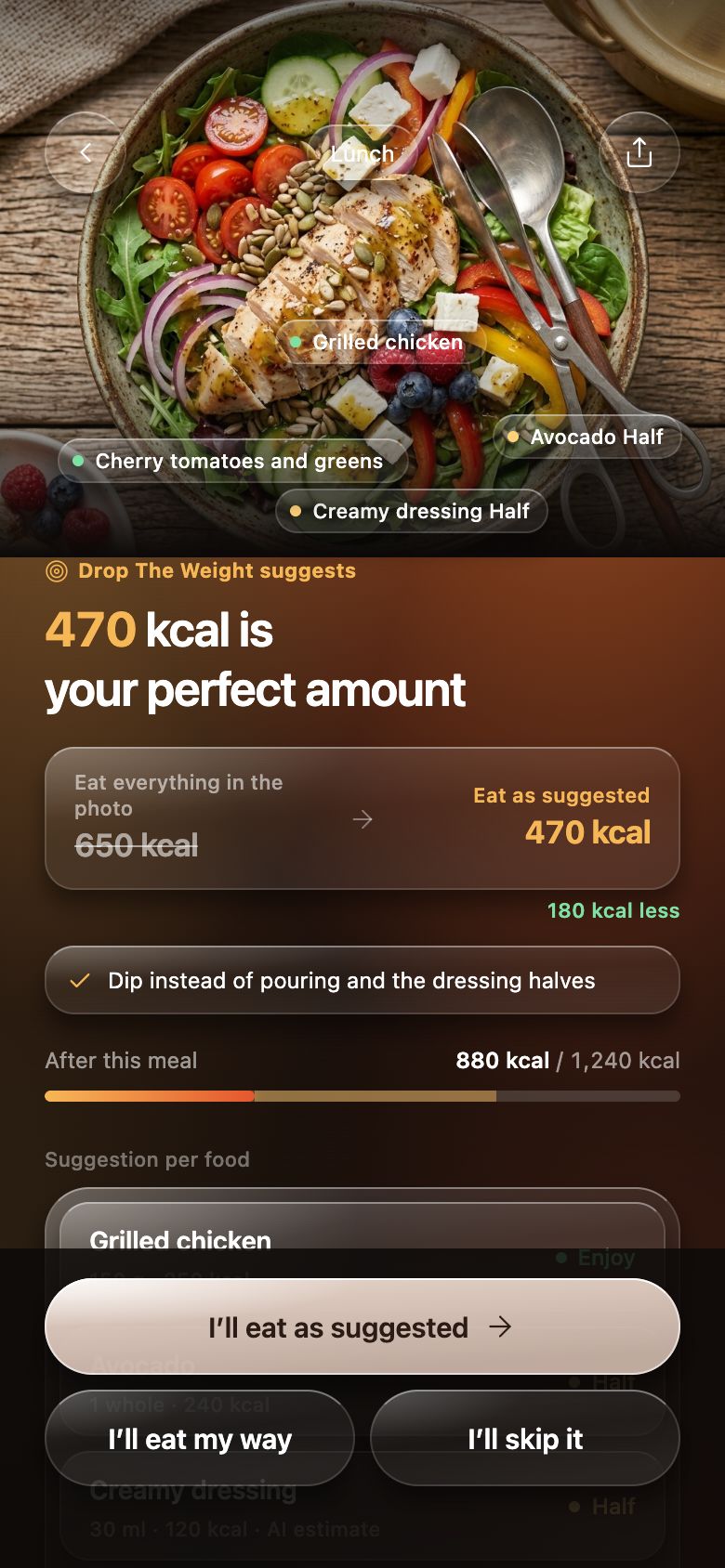
- Snap one photo before you eat and see calories, carbs, protein and fat for each dish, which makes planning a weight-loss menu easier.
- It suggests Enjoy, Half or Just 1/3 based on the calories you have left today, so you can trim rice, pasta and dessert portions without strict rules.
- Your weight log and goal, plus weekly and monthly reports, show your progress toward losing 3% or 5% at a glance.
Snap before you eat
One photo tells you Enjoy · Half · Just 1/3 for every dish
AI estimates each dish and fits it to the calories you have left today. No sign-up needed.
 Get the iPhone appFree on the App Store · Android soon
Sources
- American Association for the Study of Liver Diseases (AASLD), Practice Guidance on Nonalcoholic Fatty Liver Disease (2018)
- National Institute of Diabetes and Digestive and Kidney Diseases (NIDDK), NAFLD & NASH
- European Association for the Study of the Liver (EASL) · EASD · EASO, Clinical Practice Guidelines on MASLD (2024)
- World Health Organization (WHO), Guideline: Sugars intake for adults and children (2015)
This article is general nutrition information and does not replace diagnosis or treatment. If you have a medical condition or take medication, talk to your doctor or a dietitian before changing your diet. Drop The Weight is a meal logging and guidance app, not a medical device.