
 한국어
 日本語
 简体中文
 Español
How Much Protein Do You Need a Day? 0.8 g per kg + Chart by Weight
Most healthy adults need about 0.8 g of protein per kilogram of body weight per day (roughly 0.36 g per pound). The World Health Organization (WHO) and the Food and Agriculture Organization (FAO) set 0.83 g/kg of good-quality protein as the "safe level of intake," which works out to about 50 g a day for someone who weighs 60 kg. You may need more depending on your age, how active you are and whether you're trying to lose weight, so below you'll find a chart by body weight, the protein in everyday foods and a sample day of eating.
How much protein do you need per day?
Protein is the nutrient your body uses to build muscle, skin, hair, enzymes and antibodies, and because the body can't store it the way it stores fat, you need to get it from food every day (WHO · FAO · UNU, 2007). The major international recommendations are very close to one another.
| Organization | Recommendation for healthy adults |
|---|---|
| WHO · FAO · UNU (2007) | 0.83 g per kg of body weight |
| U.S. National Academies (RDA) | 0.8 g per kg of body weight |
| European Food Safety Authority (EFSA) | 0.83 g per kg of body weight |
| U.S. National Academies, share of calories | 10–35% of daily calories |
That 0.8 g figure is the amount that covers the needs of nearly all healthy adults. Think of it as a minimum to reach rather than an ideal target. Needs go up during pregnancy: the U.S. National Academies recommend about 1.1 g/kg from the second trimester on.
How many grams for your weight? Protein chart by situation
The math is simple: your weight in kg × the recommended grams per kg. (To convert pounds to kilograms, divide by 2.2: 50 kg is 110 lb, 70 kg is 154 lb, 90 kg is 198 lb.) In the chart, 0.8 g/kg is the baseline, 1.2 g/kg fits people over 65 or losing weight, and 1.6 g/kg fits people who do strength training. If you carry a lot of extra weight, many professionals base the calculation on a healthy goal weight rather than your current weight.
| Weight | 0.8 g/kg | 1.2 g/kg | 1.6 g/kg |
|---|---|---|---|
| 50 kg | 40 g | 60 g | 80 g |
| 60 kg | 48 g | 72 g | 96 g |
| 70 kg | 56 g | 84 g | 112 g |
| 80 kg | 64 g | 96 g | 128 g |
| 90 kg | 72 g | 108 g | 144 g |
- Age 65 and older: As we age, our muscles respond less to the same amount of protein. The PROT-AGE Study Group recommends 1.0–1.2 g/kg a day for healthy adults over 65 (J Am Med Dir Assoc, 2013).
- Regular exercise: The International Society of Sports Nutrition (ISSN) considers 1.4–2.0 g/kg enough for most exercising people to build and maintain muscle (2017).
- Losing weight: When you cut calories, you tend to lose some muscle along with fat. Weight-loss studies have often used around 1.2–1.6 g/kg to help preserve muscle and keep people feeling full.
Which foods are high in protein? Protein in common foods
Foods with the same amount of protein can come with very different amounts of fat and calories. Portions are 100 g (3.5 oz) unless noted. The values below are approximate, based on USDA FoodData Central and similar databases, and vary by brand and cooking method. Firmer tofu has more protein.
| Food | Amount | Protein (approx.) |
|---|---|---|
| Chicken breast (cooked) | 100 g | 31 g |
| Lean beef (cooked) | 100 g | 26 g |
| Canned tuna in water (drained) | 100 g | 20–25 g |
| Salmon (cooked) | 100 g | 22 g |
| Tofu | 100 g | 8–15 g |
| Plain Greek yogurt | 100 g | 10 g |
| Edamame | 100 g | 11 g |
| Lentils or chickpeas (cooked) | 100 g | 9 g |
| Milk | 200 mL | 7 g |
| Egg | 1 large | 6 g |
| Almonds | 30 g | 6 g |
| Rolled oats (dry) | 40 g | 5 g |
| Cooked rice | 200 g | 5 g |
For reference: 200 mL of milk is about 3/4 cup, 30 g of almonds is a small handful, 40 g of dry oats is about 1/2 cup, and 200 g of cooked rice is about 1 cup.
How to choose: Get your protein from a mix of sources such as fish, eggs, beans, tofu, lean meat and unsweetened dairy. Processed meats like sausage, bacon and ham are classified as Group 1 carcinogens by the WHO's International Agency for Research on Cancer (IARC), and they're also high in saturated fat and sodium, so keep them occasional. If cholesterol is a concern, see how to lower LDL cholesterol with diet as well.
If you eat only plant protein: Legumes are relatively low in methionine and grains are relatively low in lysine. Eating both grains and legumes over the course of the day lets each fill in what the other lacks, so beans with whole-grain bread or rice work well together.
Is it bad to eat it all at once? How to spread protein across meals
It's better to spread protein evenly across breakfast, lunch and dinner than to pack most of it into dinner. A review of the research suggests about 0.4 g/kg per meal (about 24 g for a 60 kg person), eaten three to four times a day, to support muscle building (J Int Soc Sports Nutr, 2018).
Many people eat plenty of protein at dinner but have just toast or cereal and coffee at breakfast. Adding a couple of eggs, a cup of Greek yogurt or a glass of milk in the morning makes a big difference. Eating vegetables and protein before your starches may also help keep blood sugar steadier; read more in the best food order for blood sugar.
Sample high-protein day (about 80 g)
This example gets someone who weighs 60–70 kg (132–154 lb) to roughly 1.2 g/kg.
| Meal | Protein |
|---|---|
| Breakfast 2 eggs + 40 g oatmeal + 200 mL milk | about 24 g |
| Lunch 1 cup rice + 100 g baked salmon + big green salad | about 27 g |
| Snack 100 g Greek yogurt + fruit | about 10 g |
| Dinner 100 g tofu stir-fry + lentil vegetable soup + vegetables | about 20 g |
| Total | about 80 g |
When you eat out, it's usually enough to check that your meal includes one clear protein. If you're ordering pasta, a sandwich or a pizza, choose an option with chicken, fish, eggs, beans or lean meat, or top up later with a yogurt or a glass of milk. At a salad bar, add eggs, chickpeas or grilled chicken rather than relying on the croutons and dressing.
3 common myths
- "The more protein you eat, the more muscle you build": Muscle grows only with exercise. Protein beyond what you need is used for energy or can be stored as fat.
- "You need protein shakes to get enough": If you can meet your needs with food, supplements aren't necessary. Think of them as a convenience for busy days, not a requirement.
- "A high-protein diet always damages your kidneys": There's no clear evidence that a moderately high-protein diet harms healthy kidneys. But if you have kidney disease, you may actually need to limit protein, so talk to your doctor first.
Checklist to start today
- ☐ Did you work out your daily target (your weight in kg × 0.8, or × 1.2)?
- ☐ Did you add a protein like eggs, yogurt or milk to breakfast?
- ☐ Did lunch and dinner each include a palm-sized portion of fish, meat, tofu or beans?
- ☐ Did you choose fish, beans or eggs instead of processed meat?
- ☐ Did you swap a packaged snack for nuts or yogurt?
FAQ
Can eating too much protein be a problem?
No official upper limit has been set for healthy adults. But if you load up on protein alone, it's easy to crowd out fiber and vegetables, and leaning on red and processed meat brings extra saturated fat and sodium with it. Getting protein from a variety of foods is the safer approach.
Can I eat more protein if I have kidney disease or diabetes?
Don't decide on your own. If your kidney function is reduced, you may need to limit protein, and if you take medication for diabetes or kidney disease, talk to your doctor or a registered dietitian before changing your diet. Never reduce or stop medication on your own because you've changed how you eat.
Does eating more protein help you lose weight?
Protein keeps you full for longer and can help limit muscle loss while you're eating fewer calories. But your weight ultimately depends on your total calories, so when you add protein, it's important to adjust the amount of other foods you eat.
Is plant protein alone enough?
Yes. Eating a variety of beans, tofu, lentils, nuts and whole grains can easily cover your needs. If you're vegan, also make sure you get enough of other nutrients such as vitamin B12.
Try it with Drop The Weight
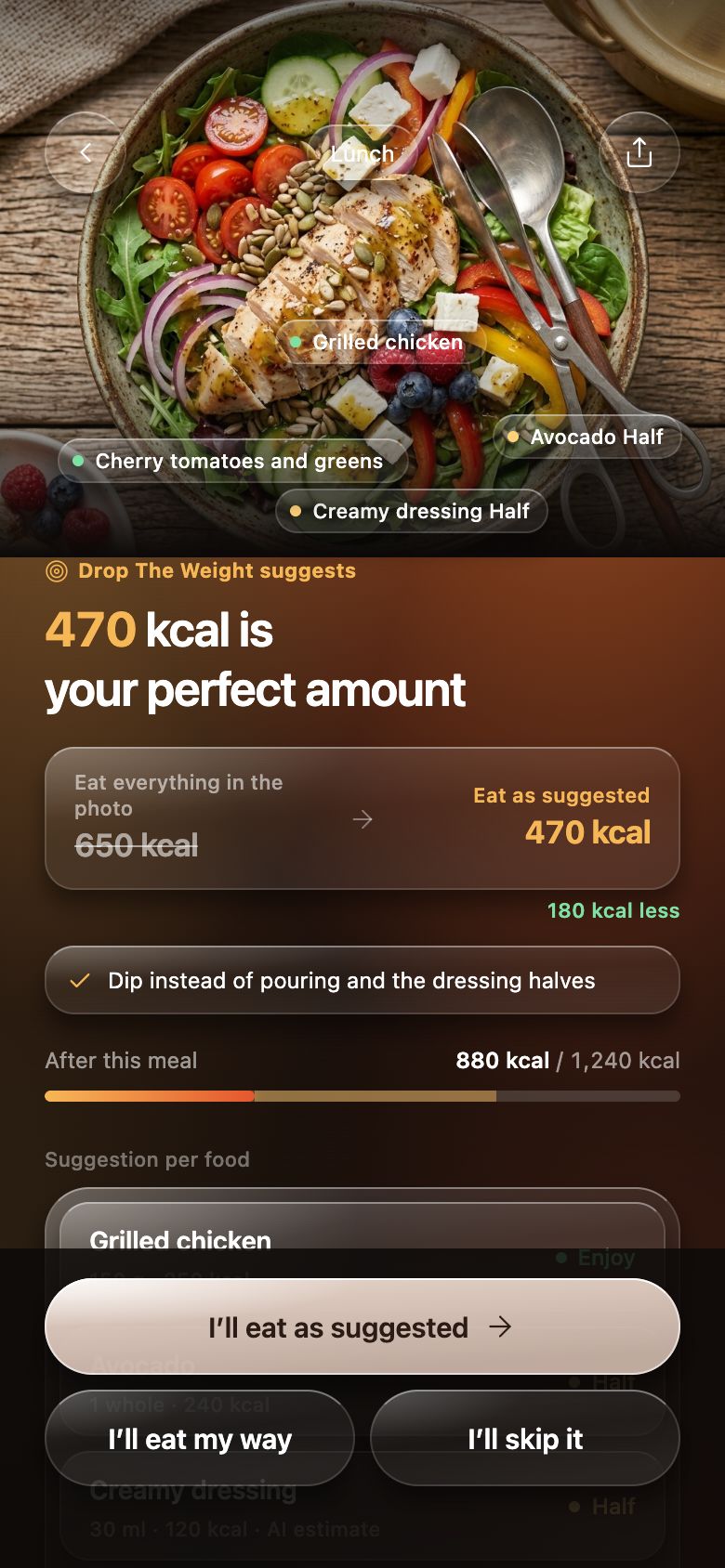
- Snap one photo before you eat and see calories, carbs, protein and fat for each item, so you know right away how much protein is on your plate.
- For packaged foods like yogurt, soy milk and protein bars, scan the barcode or nutrition label to check the protein (barcode scans are always free).
- Daily and weekly reports with your DTW score show how often you fall short on protein, and weight tracking helps you stay on course toward your goal.
Snap before you eat
One photo tells you Enjoy · Half · Just 1/3 for every dish
AI estimates each dish and fits it to the calories you have left today. No sign-up needed.
 Get the iPhone appFree on the App Store · Android soon
Sources
- World Health Organization (WHO) · FAO · UNU, Protein and amino acid requirements in human nutrition, WHO Technical Report Series 935 (2007)
- National Academies (formerly IOM), Dietary Reference Intakes for Energy, Carbohydrate, Fiber, Fat, Fatty Acids, Cholesterol, Protein, and Amino Acids (2005)
- Bauer J et al., Evidence-based recommendations for optimal dietary protein intake in older people: a position paper from the PROT-AGE Study Group, J Am Med Dir Assoc (2013)
- Jäger R et al., International Society of Sports Nutrition Position Stand: protein and exercise, J Int Soc Sports Nutr (2017)
- European Food Safety Authority (EFSA), Scientific Opinion on Dietary Reference Values for protein (2012)
This article is general nutrition information and does not replace diagnosis or treatment. If you have a medical condition or take medication, talk to your doctor or a dietitian before changing your diet. Drop The Weight is a meal logging and guidance app, not a medical device.